- Gerry FP's Thought Lab
- Posts
- Why Sales AI Agents Haven’t Replaced Humans (Yet)
Why Sales AI Agents Haven’t Replaced Humans (Yet)

Gerry Fernando Patia
October 19, 2025
When ChatGPT went viral two years ago, it sparked panic across the sales world. Many sales professionals began wondering if AI would soon make their roles obsolete. CROs were suddenly under pressure from their boards to “implement an AI sales strategy.” And if you happened to be in San Francisco, you couldn’t miss the billboards from startups like Artisan and Qualified, all promising the rise of powerful AI sales agents.
Sales leaders started reallocating headcount budgets toward AI, buying into the dream that an AI SDR could deliver 10x the output of a human rep. The SDR role was the first to be tested - given how repetitive and process-driven it is.
Two years later, that promise hasn’t materialized. As I’ve been building and selling Dokai, I’ve learned firsthand the inner workings of AI SDRs and more importantly, their limitations. Here’s what I’ve discovered about why AI SDRs haven’t replaced human ones.
Replacing SDR with AI Impact
Gibberish message quality (worse than generic templates)
Lower reply rates
More emails marked as spam
Domains getting flagged (hurting the entire company)
Damaged company reputation
After speaking with numerous sales leaders, one thing is clear: replacing SDRs with AI has been a complete disaster.
The companies that failed didn’t just augment their SDRs with AI, they gave AI full autonomy over the process, from prospecting to personalization to sequencing. The results were worse than expected.
AI SDRs reached out to unqualified leads, sent incoherent messages, and tanked reply rates. Worse, they triggered spam filters across email and LinkedIn, hurting company-wide deliverability and brand reputation. What was supposed to be an efficiency boost became a reputational nightmare.
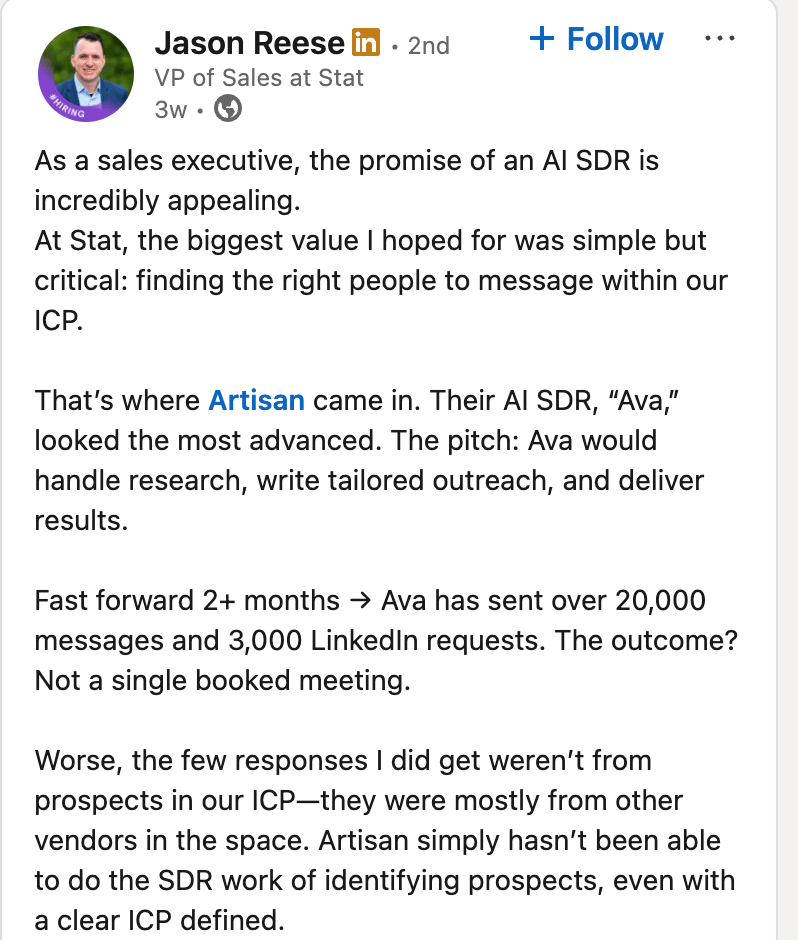
AI SDR User Testimony
The Core Problems with AI SDRs
After thousands of conversations with sales leaders, and after trying to build AI SDRs myself, I’ve realized one fundamental truth:
It’s nearly impossible to replicate what a high-performing human SDR does.
It’s not just that the technology is still immature. The very infrastructure that AI operates within the web, APIs, and data access layers is completely different from how humans sell. And most importantly, sales still depends heavily on human intuition.
In Sales, Human Touch Wins
Coming from an engineering background, sales initially felt like a black box to me. But after two years as a founder, I’ve come to realize that sales is just as complex as engineering - if not more so.
The best sales reps succeed because they lead with empathy. They can read between the lines, sense intent, and adapt their tone; things that are extremely hard to replicate in AI.
For example, when a great SDR disqualifies a lead, it’s not just based on a checklist. It’s often a mix of subtle cues and gut instinct, the kind of judgment that comes from experience and emotional awareness.
While researchers are working on integrating emotion and intuition into AI systems, that technology is still in its infancy.
AI Isn’t as “Smart” as It Looks
LLMs like ChatGPT can feel incredibly intelligent, especially when answering questions we don’t know ourselves. But once you start asking questions in a domain you deeply understand, you quickly see their limits.
LLMs excel at recognizing and replicating patterns they’ve seen before. But that also means they often operate with tunnel vision, focusing on narrow workflows or repeating familiar reasoning paths.
In prospect research, for example, where context and nuance vary from one company to another, this pattern-based thinking leads to poor judgment. The AI ends up missing the bigger picture that a human rep would naturally perceive.
The Internet Itself Isn’t Built for AI Agents
Even if the AI model were perfect, the internet infrastructure it relies on isn’t ready.
Humans can freely navigate tools, websites, and platforms, but AI agents can’t. Many SaaS tools restrict AI access for privacy, security, or competitive reasons. This means that AI agents often operate with incomplete or inferior data compared to humans.
As a result, AI SDRs are limited not just by intelligence, but by access too, unable to see or interpret the same signals that a human seller can.
Final Thoughts
The dream of the autonomous AI SDR is compelling, but the reality is far more complex. The best-performing sales teams aren’t replacing their reps - they’re augmenting them.
Yes AI can accelerate research, draft messages, and automate repetitive tasks but the heart of sales remains human, and a highly customize solution is needed. Until AI can truly replicate empathy, intuition, and trust, the Sales AI Agent won’t replace the Sales Rep - it’ll only make them stronger.
Reply